

Introduction
Writing an English composition can feel like one of the most demanding parts of the PSLE English exam, even for children who enjoy telling stories. Many students know what they want to write but struggle to shape those thoughts into a structured, coherent piece of writing that meets exam expectations.
The good news is that writing is not a matter of talent alone. With the right frameworks and strategies, English composition writing is a skill that can be taught, practised, and refined. Below, we break down how the PSLE composition paper works, the core skills students need to master, and tips to help them plan, structure, and write confidently under exam conditions.
Key Takeaways
- Good English composition writing is a skill that can be nurtured. With the right structure and approach, students can learn to write clear and engaging compositions.
- Strong compositions rely on core skills like analysing the question, structuring ideas, writing clearly, and refining work.
- Avoid common English composition writing mistakes like rushed endings, memorised phrases, and tense errors. These can weaken your writing.
- Focus on clear and purposeful expression. Logical flow, emotional expression, and using the appropriate vocabulary make compositions more engaging and effective.
- Curion Education Centre’s English tuition classes for PSLE use a structured approach to help students generate ideas quickly and write confidently without memorisation.
Understanding the PSLE English Paper 1
Inside PSLE English Paper 1: What to Expect
Before students can write well, they need a clear understanding of what the exam actually requires. Paper 1 is the first component of the PSLE English examination, which lasts 1 hour 10 minutes and accounts for 25% of the total score. It assesses both functional and creative writing skills and is divided into two key sections.
Situational Writing (14 Marks)
Students are typically presented with a visual stimulus, such as a poster, flyer, or comic strip, and are tasked with writing a short functional piece, such as an email, formal letter, or report.
To do this well, students need to be clear about why they are writing, who they are writing to, and the appropriate tone and format. Although the structure is more guided, it still requires careful attention to clarity, relevance, and detail.
Continuous Writing (36 Marks)
This component requires students to write a composition of at least 150 words based on a given theme and at least one of the three provided pictures.
Students may choose one image or combine elements from multiple images, but the key requirement is relevance. The storyline must clearly connect to the chosen prompt and reflect a coherent theme throughout the composition. This is where students must showcase their ability to apply a full range of English composition writing skills. They must interpret visual information, organise their ideas, and express them clearly within a limited time frame, making preparation and familiarity with the task structure especially important.
Core English Composition Writing Skills You Need to Master
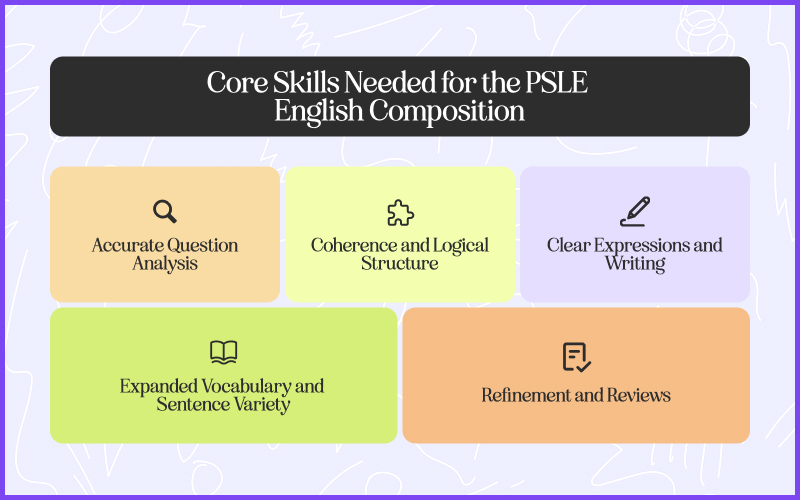
To perform well in PSLE English Paper 1, students must master a set of core composition writing skills that work together to produce clear, engaging, and exam-ready work.
Analysing the Question Accurately
Every composition begins with understanding the prompt. Students need to identify the main theme, key event, and emotional focus presented in the visuals.
For example, if a prompt shows a child standing alone outside a classroom while others are inside, the surface event is simple. However, the deeper focus may revolve around emotions such as anxiety, regret, or determination. A response that focuses solely on describing the scene may feel flat, whereas one that explores the emotional experience aligns more closely with what examiners are looking for.
When the question is misinterpreted, students may write a well-written story that is irrelevant to the prompt, which can affect their score.
Structuring a Coherent and Logical Storyline
A strong composition follows a clear narrative progression, where each part builds on the previous one. A well-structured story should include:
- Introduction: Who, where, and what is happening
- Build-up: The problem or tension begins
- Climax: The most important turning point
- Resolution: The outcome and lessons learnt
Without this structure, students may jump between ideas, introduce events too abruptly, or end the story too quickly, making the narrative feel incomplete.
Writing with Clarity and Expression
Effective English composition writing communicates ideas clearly while still engaging the reader.
Compare the following:
- “I was very scared.”
- “My heart pounded as I froze at the doorway, unsure of what to do next.”
Both sentences express fear, but the second shows the emotion through action and detail. This creates a more vivid and engaging reading experience without making the sentence overly complex.
Expanding Vocabulary and Sentence Variety
Stronger compositions demonstrate variety in both word choice and sentence structure.
For example:
- Basic: “The dog ran very fast.”
- Improved: “The dog sprinted across the field, its paws barely touching the ground.”
The second sentence uses more precise vocabulary and imagery, making the scene more dynamic. Similarly, varying sentence lengths helps create rhythm. A combination of short and longer sentences prevents the writing from sounding repetitive.
Reviewing and Refining for Accuracy
Strong English composition writing is not just about getting ideas down on paper, but also about shaping them into a clear and consistent final piece. Taking time to review for grammar, flow, and overall coherence helps smooth out awkward phrasing and correct small mistakes. This final step makes the composition easier to read and strengthens its overall quality.
Strategies That Turn Good Writing into Great PSLE English Compositions

Understanding the exam format and core skills is only the first step. What helps students move from average to high-scoring compositions is how they apply these skills under exam conditions. Here are some writing tips for PSLE students to help them write with more control and purpose.
Common Composition Mistakes Made by Primary School Students
1. Weak or Rushed Endings
One of the most common mistakes when writing an English composition is an underdeveloped conclusion. Students often spend too much time on the beginning, leaving the story to end abruptly.
For example:
- Weak ending: “Then everything was fine and I went home.”
- Stronger ending: “As I walked home, I realised how my small decision had changed everything. It was a lesson I would never forget.”
The first simply ends the story. The second resolves the conflict and reflects on its meaning, which leaves a stronger impression.
2. Overuse of “Model” Phrases or Memorised Openings
Many students rely heavily on memorised introductions or descriptive phrases, hoping they will fit any topic. While this may seem helpful, it often results in writing that feels unnatural or forced.
For example, many memorised openings sound like this:
- “The bright blue sky stretched endlessly above me, dotted with cotton-like white clouds drifting in the gentle breeze.”
While descriptive, phrases like “bright blue sky” and “cotton-like white clouds” are overused and add little to the story if they are not relevant.
Instead, opt for a stronger opening that keeps the description but ties it directly to the situation, such as:
- “The bright blue sky stretched above the school field, but my grip tightened on the trophy as dark clouds gathered in the distance.”
This makes the description purposeful by linking it to the character’s emotions and the unfolding situation, creating a clearer and more engaging start to the story. Students need to learn to adapt their writing to the question’s context, rather than relying on fixed phrases that may not fit every situation.
3. Inconsistent Tense and Point of View
Students with a weaker grasp of English tend to switch between past and present tense, or between first-person and third-person narration, without realising it. This disrupts the flow of the story and makes the writing harder to follow. When the perspective or timeline keeps changing, it can confuse the reader and weaken overall clarity. Maintaining consistent tense and point of view shows stronger control over writing and helps their English composition feel smoother and more coherent.
How to Analyse the Question and Outline Your Story
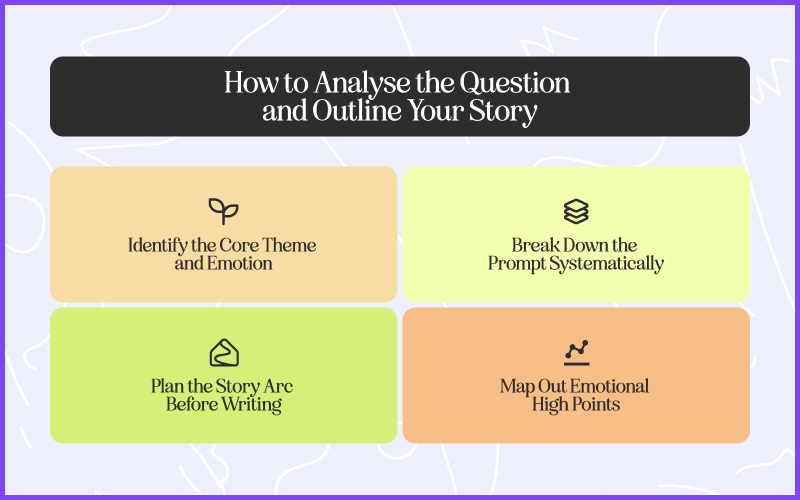
When writing an English composition, avoid jumping straight into writing. Instead, take a moment to think through your ideas and build a clear story. Here are some techniques to help you break down the continuous writing process and stay on track.
Identify the Core Theme and Emotion
Start by asking yourself what the story is really about. Look beyond the obvious action in the picture and think about the underlying theme and emotion.
For example, if the prompt shows a boy returning a lost wallet, do not just focus on the act itself. Think about what it represents, such as honesty, responsibility, or doing the right thing even when it is difficult. A stronger story explores the character’s thoughts and feelings, not just what happens.
Break Down the Prompt Systematically
Instead of jumping straight into writing your English composition, take a moment to unpack the prompt using a few guiding questions:
- Who is involved?
- What is happening?
- Where and when does it take place?
- Why does this event matter?
For instance, if the scene shows a crowded MRT platform with someone dropping a bag, you might identify a busy setting, a moment of urgency, and a decision the main character has to make. This gives you a clear direction before you start writing.
Plan the Story Arc Before Writing
Next, outline your story in a simple sequence so you know where it is going.
For example:
- Introduction: You notice the crowded platform
- Build-up: Someone drops a bag and disappears into the crowd
- Climax: You must decide whether to chase after them or ignore it
- Resolution: The bag is returned, followed by a reflection
Having this structure in mind guides the planning and organisation process, preventing your story from becoming rushed or incomplete.
Map Out Emotional High Points
Think about how the emotions in your story will change from beginning to end. A good composition is not just about events but also about how the character feels and reacts.
For example, in a story about getting lost:
- Tension: You realise you are in an unfamiliar place
- Peak: Panic sets in when you cannot find help
- Resolution: Relief when you are finally safe
Planning these emotional moments makes your story more engaging and realistic.
At Curion, our formulated composition writing classes use the FormuFlow method to help students develop this level of control. Our proprietary system is built around 4 Core Story Themes aligned with almost every PSLE question type. This serves as a mental framework for generating ideas, helping students approach any composition question systematically using a flowchart. This enables them to generate engaging plot ideas and build a clear, relevant storyline without relying on rote memorisation.
Write Like a Pro: Structure, Style, and Expression

Once your ideas are planned, it’s time to express them in a clear, engaging, and purposeful way. Here are some English composition writing tips that can help:
Maintain Logical Flow and Transitions
As you write, make sure your story moves in a clear and natural sequence. Each event should lead smoothly to the next, so the reader can follow your thinking without confusion. When ideas are placed side by side without connection, the story can feel abrupt or disjointed.
For example:
- Abrupt: “I found the wallet. I returned it. I went home.”
- Improved: “After spotting the wallet on the ground, I hesitated for a moment. Then, I picked it up and ran after the man who had dropped it.”
The second version shows a clear progression of events and helps the reader understand what is happening, step by step.
Show, Don’t Tell
“Show, don’t tell” is a common piece of writing advice, but it can be challenging for primary school students to apply. Instead of directly stating emotions, focus on describing what the character does, thinks, or notices. By showing reactions and small details, the writing becomes more vivid and helps the reader better understand and experience the moment.
- Telling: “I was very scared.”
- Showing: “My hands trembled as I edged closer to the dark corridor, my heartbeat echoing in my ears.”
The second sentence gives a clearer picture of how the character feels without directly stating the emotion. This makes the writing more vivid and helps the examiner engage more deeply with the story.
Use Vocabulary Purposefully
In PSLE English composition writing, using “big” words does not necessarily lead to better marks. What matters more is whether the vocabulary fits the context and is used correctly. Choose words that match the situation rather than trying to use complex vocabulary for the sake of it.
For example:
- Forced: “I was utterly jubilant and overwhelmed with immense elation.”
- More natural: “I could not stop smiling as I held the trophy in my hands.”
While the first sentence uses complex vocabulary, it comes across as exaggerated and repetitive. The second expresses the same idea more clearly and naturally, which is often more effective in exam writing.
At Curion Education Centre, our composition writing tuition classes for Primary 5 students focus on building these skills. Through activities like the Emotion & Tone Game, students work with emotional cues and practise expressing tone, reactions, and body language more naturally in their writing. This approach helps students move from simply writing a complete story to crafting one that is more engaging and expressive.
Frequently Asked Questions
1. How can my child come up with more creative ideas for compositions?
While creativity plays a role, writing PSLE English compositions isn’t just about coming up with completely new or unusual ideas every time. Examiners will assess students on how well they can understand the question and develop a clear, logical story. When students are able to recognise the common themes that most continuous writing prompts are built on, they’ll be able to write and respond more confidently. As such, students tend to benefit best from a systematic framework and approach that allows them to tackle composition questions quickly and on the spot under exam conditions.
2. How often should my child practise English composition writing before the PSLE?
It is not necessary for them to practise writing English compositions every day. What really matters is quality practice. One well-planned composition each week gives your child enough time to review their work, apply feedback, and improve specific areas such as structure or expression. Over time, this leads to steady progress and stronger confidence.
3. What should I look out for when reviewing my child’s composition?
It is common for parents to focus mainly on grammar, but it is equally important to look at the overall story. Read the composition as a whole and check if the story makes sense. Does it have a clear beginning, middle, and end? Does your child show how the character feels or how they change? At the same time, acknowledge effort and improvement. This keeps your child motivated and more willing to learn from feedback.
Conclusion
Strong English composition writing does not develop overnight. It improves over time through clear structure, consistent practice, and thoughtful feedback. When students learn how to plan their ideas, express emotions effectively, and organise their stories with purpose, the PSLE English Composition Exam can become more manageable and far less intimidating.
At Curion, we go beyond teaching composition writing and rote memorisation. Through our FormuFlow method, we’ll help your child learn to analyse any continuous writing question systematically and build structured, exam-ready responses.
With our Skill Pillar framework, our teachers can track your child’s progress in our English enrichment classes, allowing us to identify and strengthen specific areas for improvement. At the same time, our engaging classroom activities spark curiosity and make learning more meaningful, so your child not only improves but also enjoys the process.
For more information about our approach, speak with the team today.