

Does your child memorise model English essays yet struggle to write independently? Or perhaps they tend to score well in multiple-choice questions but freeze during oral exams. You may also notice their results plateauing, even after completing numerous practice papers.
As a parent, your natural response might be to increase the frequency and intensity of their practice. More worksheets, more model answers, more repetition. But while such an approach may achieve short-term familiarity with exam formats, it rarely produces lasting improvement.
This is because English proficiency in children is not built through drilling alone. It develops through a set of core, interconnected abilities that shape how a child reads, processes, and expresses ideas. Just as a plant cannot grow strong leaves solely from fertiliser, children cannot develop strong English from practice papers alone.
This is why Curion Education Centre, a trusted English tuition centre in Singapore, created the Skill Pillars Framework. Below, we take a closer look at how this systematic approach helps improve English for kids from the ground up, one “pillar” at a time.
Key Takeaways
- Real progress in English for kids comes from building core skills, not just doing more practice papers.
- Curion’s Skill Pillar framework develops six core skills (reading, writing, speaking, listening, grammar, and vocabulary) to drive consistent improvement.
- Practice papers reveal gaps, but they do not fix the underlying issues behind weak performance.
- Curion’s structured approach helps children understand, organise, and express ideas with greater clarity and confidence.
- When foundational skills are strong, children become more adaptable, independent, and capable across all components of English.
Why English for Kids Requires a Deeper, Structured Approach

Before children can write beautifully or score well, several underlying skills need to be in place. These are the foundations that support how they understand, process, and use language in different situations:
- Comprehension habits: How a child reads and makes sense of text. Strong comprehension habits mean they actively engage with what they read by identifying key ideas, making inferences, and understanding the deeper meaning behind questions.
- Mental language structures: Children need an internal framework for how sentences and ideas are formed. This allows them to organise their thoughts clearly, instead of relying on memorised phrases or copying model answers.
- Input depth (vocabulary and grammar): A child’s exposure to vocabulary and grammar must go beyond surface memorisation. They need to understand how words and sentence structures work in context, so they can apply them naturally in different situations.
- Processing fluency: This refers to how quickly and accurately a child can think through information. Whether in comprehension, listening, or oral exams, strong processing fluency allows them to respond without hesitation or confusion.
- Output confidence: Even when children understand the language, they may struggle to express it. Output confidence is the ability to communicate ideas clearly in writing and speaking without second-guessing themselves.
Practice papers do not build these skills. They are designed to test performance, not develop the abilities behind that performance. When drilling continues without strengthening these foundations, learning can start to feel:
- Repetitive, with little sense of progress
- Stressful, as effort does not translate into results
- Frustrating for parents who are unsure what is missing
- Demotivating for students who begin to lose confidence
A child may complete 100 exam papers, but if they still lack vocabulary, sentence structure, or effective comprehension strategies, improvements will remain limited. Over time, this often leads to burnout and plateauing English grades for kids.
Common Struggles Children Face When Learning English
Many of the challenges parents see are not random. They are symptoms of specific gaps in underlying skills.
| Symptom | Root Cause |
| Weak writing despite repeated practice | Limited vocabulary and weak sentence structures |
| Struggling to answer inferential comprehension questions | Lack of reading strategies |
| Persistent grammar mistakes | Rules memorised, not internalised |
| Hesitation in speaking | Lack of structured practice and confidence in forming responses |
| Forgetting newly learned words | No semantic vocabulary network built |
| Freezing or panicking during oral exams | Limited experience with spontaneous speaking |
Introducing Curion’s Skill Pillars: A Framework for Real Progress
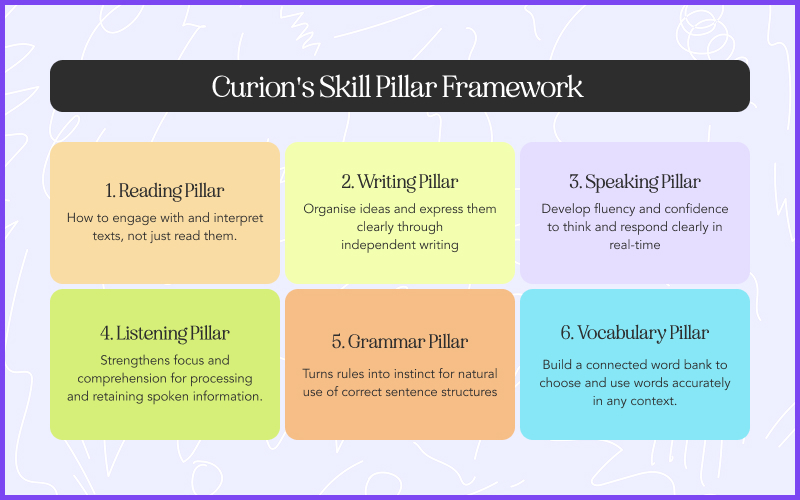
To build strong English for kids, Curion’s Skill Pillars Framework focuses on six foundational pillars that work together to shape how a child understands and uses language. Our English tuition classes are structured around these pillars, ensuring that every lesson targets specific skills, strengthens underlying gaps, and guides students towards consistent, measurable progress.
1. Reading Pillar (Input Depth + Critical Interpretation)
Reading is the primary channel through which language patterns enter the brain.
At Curion, we nurture both the habit and depth of reading in young children through:
- Exposure to high-quality, age-appropriate texts that model strong language use
- Strategy-based comprehension techniques that guide how they read and think
- Question dissection to help them understand exactly what is being asked
- Development of inferential and critical thinking skills
- Annotation and active interaction with texts to deepen engagement and retention
In our English enrichment classes for K1 students, reading is woven into lessons and designed to be immersive and engaging. Teachers will introduce an original Curion storybook that draws them into a mystery to solve. These stories anchor their learning, while movement, visuals, hands-on activities, and guided discussions keep them actively engaged.
When a child reads effectively, several improvements happen naturally:
- They begin to write clearer, more structured sentences
- Grammar patterns become internalised without conscious effort
- Vocabulary expands through meaningful exposure
- They handle unseen passages with greater confidence
Developing this pillar well helps strengthen every other aspect of early English language learning, from writing to comprehension to vocabulary use.
2. Writing Pillar (Independent Expression + Structural Thinking)
Many students can memorise compositions, but few can construct meaning independently. Building strong English writing skills for kids comes from understanding how ideas are built, organised, and expressed, not from recalling pre-written content. Children need to know what to say, how to say it, and why it works.
At Curion, we focus on helping children build English writing skills from the ground up through:
- Structured planning frameworks to organise their thoughts
- Thematic modelling that teaches concepts, not templates
- Improving sentence construction and flow using syntax, cohesion, and tone
- Helping them add detail to their writing through voice, imagery, and emotional clarity
- Guided peer editing and reflective revision to learn from their mistakes and improve
In our creative writing classes for kids, this is further strengthened through Curion’s FormuFlow Method. Instead of starting from a blank page, we teach students to think systematically. Classes begin with four core story themes that serve as reliable anchors for generating ideas. From there, students will learn to break these down into sub-themes, allowing them to expand and develop on their compositions with more clarity and depth.
This approach removes the guesswork from writing. Children no longer rely on memorisation or inspiration alone. Instead, they follow a logical flow of ideas and construct meaning independently, leading to more consistent and adaptable performance across different topics.
3. Speaking Pillar (Oral Fluency and Eloquence)
Being able to speak English fluently indicates how well a child can process and express their ideas in real-time. For kids, this can also reveal gaps in their English learning that may not appear in their written work, especially when they need to respond on the spot.
At Curion, we train students to develop:
- Clear and precise articulation
- Structured narrative and explanatory speaking
- Confidence in responding under exam conditions
- The ability to speak naturally and spontaneously in conversation
- Appropriate academic vocabulary for oral responses
We reinforce these English oral skills for kids through scaffolded speaking routines, guided discussion prompts, and expressive techniques. These can help children organise their thoughts and communicate more fluently and clearly.
As children become more confident speakers, they also become more expressive writers and more engaged readers. Speaking strengthens the connection between thinking and expression, making language feel more natural and accessible.
4. Listening Pillar (Cognitive Comprehension + Retention)
Listening is often overlooked, but it’s an important aspect of English learning for kids. It trains the brain to process language quickly and accurately.
Curion’s listening curriculum focuses on building:
- Auditory decoding: Recognising and processing spoken words clearly
- Memory chunking: Breaking information into smaller parts so it is easier to remember
- Accent exposure: Becoming familiar with different accents and ways of speaking
- Note-taking: Identifying and taking down key information while listening
- Inference skills: Understanding meaning from tone, context, and what is implied, even when not directly stated
When listening skills are strengthened, children process information more efficiently. This supports better reading comprehension, clearer speech, and stronger language fluency overall.
5. Grammar Pillar (Structural Internalisation, Not Rule Memorisation)
Grammar is often taught as a set of rules, but this approach rarely leads to lasting improvement in English for kids. Instead of drilling worksheets, grammar should be:
- Visualised, allowing children to clearly see how sentence structures are formed
- Applied in context, so they understand how grammar works in real usage
- Experienced across reading and writing tasks, reinforcing patterns through exposure
- Internalised through meaningful use, so correct structures become natural over time
Curion reframes grammar as a practical tool that supports:
- Precision, helping children express ideas accurately
- Clarity, ensuring their meaning is easy to understand
- Stylistic flexibility, allowing them to vary how they write and speak
This allows grammar to become intuitive. Instead of pausing to recall rules, children begin to use correct structures naturally, integrating them into their reading, writing, and communication.
6. Vocabulary Pillar (Semantic Networks and Usage Intelligence)

Vocabulary is more than knowing definitions and practising with flashcards. When it comes to English learning for kids, real progress comes from understanding how words function in context. At Curion, we use application-based methods to help children learn:
- The difference between connotation and denotation
- Common collocations and natural phrasing
- Sensitivity to tone and context
- Appropriate use across different situations
- Word roots and affixes
Children should learn and expand their vocabulary like a living network, not as isolated words or a memorised list. This makes it easier to recall, apply, and adapt words across different tasks. Over time, children can harness vocabulary as a flexible tool for expression, communicating with greater clarity and sophistication.
How Curion Builds These English Skills for Kids, Step by Step
To develop these pillars consistently and systematically, Curion’s pedagogy follows a three-step pipeline:
1. Identify the Weaknesses
We begin by understanding where your child needs support. This is done through a combination of diagnostic tasks, written work, class participation, and responses to questions during lessons.
Instead of assuming the problem is “weak English”, we pinpoint the exact pillar that needs strengthening. For instance, a child who struggles with comprehension may need help with inferential reading, while weaker writing may stem from limited sentence variety or structure.
2. Strengthen the Root Pillar
Once the gap is clear, our English lessons for kids are designed to target that specific skill directly.
This may include:
- Sequencing and recall activities to strengthen listening and processing
- Guided paragraph construction to improve writing structure
- Text analysis and question breakdown to develop comprehension strategies
Each activity is intentional. Instead of repeating similar exercises, our teachers will help your child work on the specific skill that is holding them back.
3. Apply the Improved Pillar
After strengthening the skill, your child practises applying it across a range of tasks. This includes:
- Exam-style formats and questions
- Authentic writing tasks and composition practice
- Guided and independent oral discussions
- Brand new comprehension passages
This step is what makes improvement stick. Instead of learning a skill in isolation, your child learns how to use it flexibly in different situations.
Over time, this approach builds confidence and consistency, with improvements showing not just in one area, but across English comprehension, writing, and oral performance for kids.
Why These Pillars Matter Together
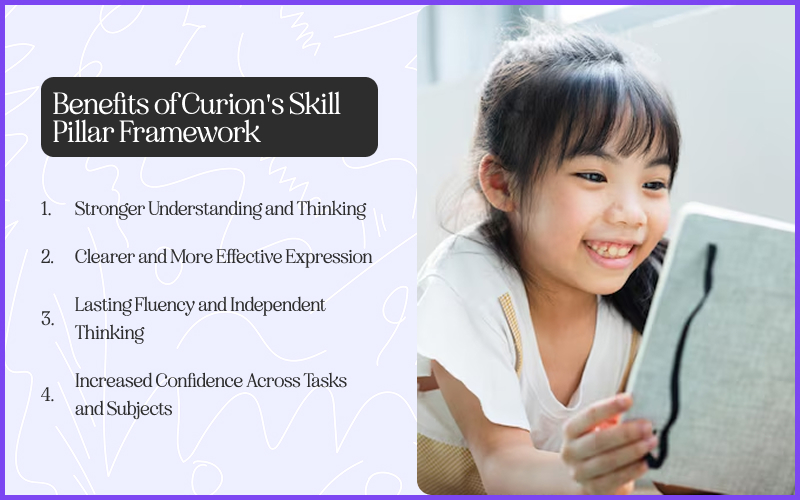
Each pillar supports a different part of English language learning for kids, but real progress happens when they develop together. When children build all six pillars simultaneously, their abilities begin to reinforce one another.
Stronger Understanding and Thinking
Your child will begin to understand texts more deeply, not just what is stated, but what is implied. At the same time, they process information faster, which helps them think through questions more clearly and respond with greater confidence.
Clearer and More Effective Expression
As their grammar, vocabulary, and sentence structure improve together, your child becomes more precise in how they express ideas. You will notice their writing becoming more organised, and their speaking more fluent and natural.
Lasting Fluency and Independent Thinking
Instead of depending on model English answers for kids, they learn how to adapt. They become more comfortable forming their own ideas and expressing them, especially in open-ended tasks where there is no single “correct” answer.
Increased Confidence Across Tasks and Subjects
Having a stronger foundation can help your child feel more in control during exams. This confidence can also carry over to other subjects, where understanding questions and explaining answers clearly becomes much easier.
How Curion Tracks Your Child’s Progress
Some parents may also have concerns about whether their child is truly improving or simply completing more work. At Curion, we aim to make our students’ progress clear, measurable, and easy to understand, so you can see exactly how your child is developing over time.
Instead of broad comments like “needs more practice,” you’ll receive specific insights such as:
- “Your child’s grammar foundation is still developing”
- “We have strengthened sentence structure and reduced common errors”
- “Next, we are focusing on improving vocabulary precision and usage”
This level of transparency ensures that everyone is on the same page. The students can see where they are improving, which keeps them motivated and engaged. At the same time, parents gain a clearer understanding of what has improved and what still needs attention at home. Even the teachers stand to benefit, as they’ll be able to adjust lessons quickly to address gaps and accelerate English progress for the kids.
How Curion’s English Learning Framework Prepares Kids for Life

Exams will continue to evolve. Formats change, expectations shift, and marking rubrics are updated over time. What remains constant, however, are the underlying skills that children carry with them. The way your child learns to think, process information, and express ideas today will shape how they perform not just in school, but in the years ahead.
Through a structured approach to English for kids, Curion focuses on developing abilities that go far beyond exam performance. Children learn to think clearly, reason through ideas, and express themselves in a way that is both precise and persuasive. They build confidence in communication and develop strong literacy skills that support them across all areas of learning.
These are the skills that universities and future workplaces value. The ability to organise thoughts, present ideas effectively, and adapt language to different contexts matters far more than memorising model answers.
Conclusion: Building Stronger English Foundations for Kids
Every parent wants to see results, but real improvement in English comes from building strong, lasting skills. At Curion, we identify the underlying causes of your child’s challenges and strengthen them systematically through our Skill Pillars Framework, helping them develop deep, transferable language mastery. If you are looking for a clearer, more effective way to enhance English learning for your kids, get in touch today to learn more about how we can help.